


EM and GPR locating across Baltimore City and Baltimore, Anne Arundel and Howard counties.

Trinity Subsurface locates private underground utilities for contractors, engineers and facility owners in Baltimore City and Baltimore, Anne Arundel and Howard counties. We find the electric, water, gas, storm, sewer and communication lines that Miss Utility does not mark, using electromagnetic (EM) equipment and ground penetrating radar (GPR). We mark them in paint and flags and deliver a field sketch within 24 hours.
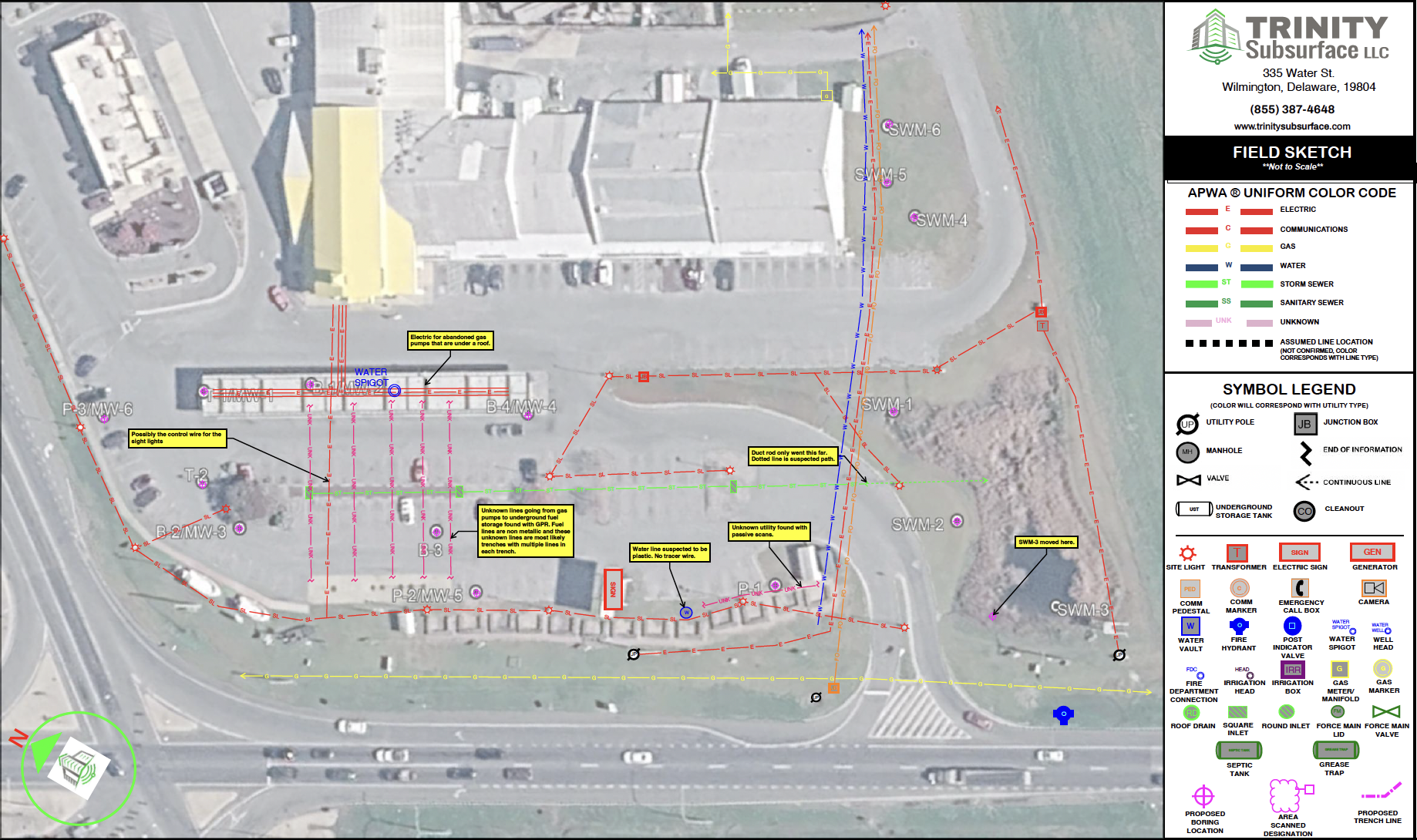
Maryland law requires a call to Miss Utility (811) before digging. But member utilities only mark their own lines, typically up to the meter or property line. On hospital and university campuses, industrial sites and commercial properties around Baltimore, the lines past that point are often undocumented: site lighting, private water and fire services, storm laterals, and feeds between buildings. They're private, so only a private locator will mark them.

Our team relies on a variety of technologies and methods to fully examine your site. We use electromagnetic scanning, ground penetrating radar and more to get the best info on subsurface utilities and underground infrastructure.

Our team offers multiple services to support your projects on top of utility locating and concrete scanning. Ask us about additional utility investigation services we can offer for further support beyond GPR locating and scanning.

We aim to provide ongoing support for your current and upcoming projects. Whether you're just starting design or running into unexpected utilities during construction, we'll investigate and assist with any step of your project.
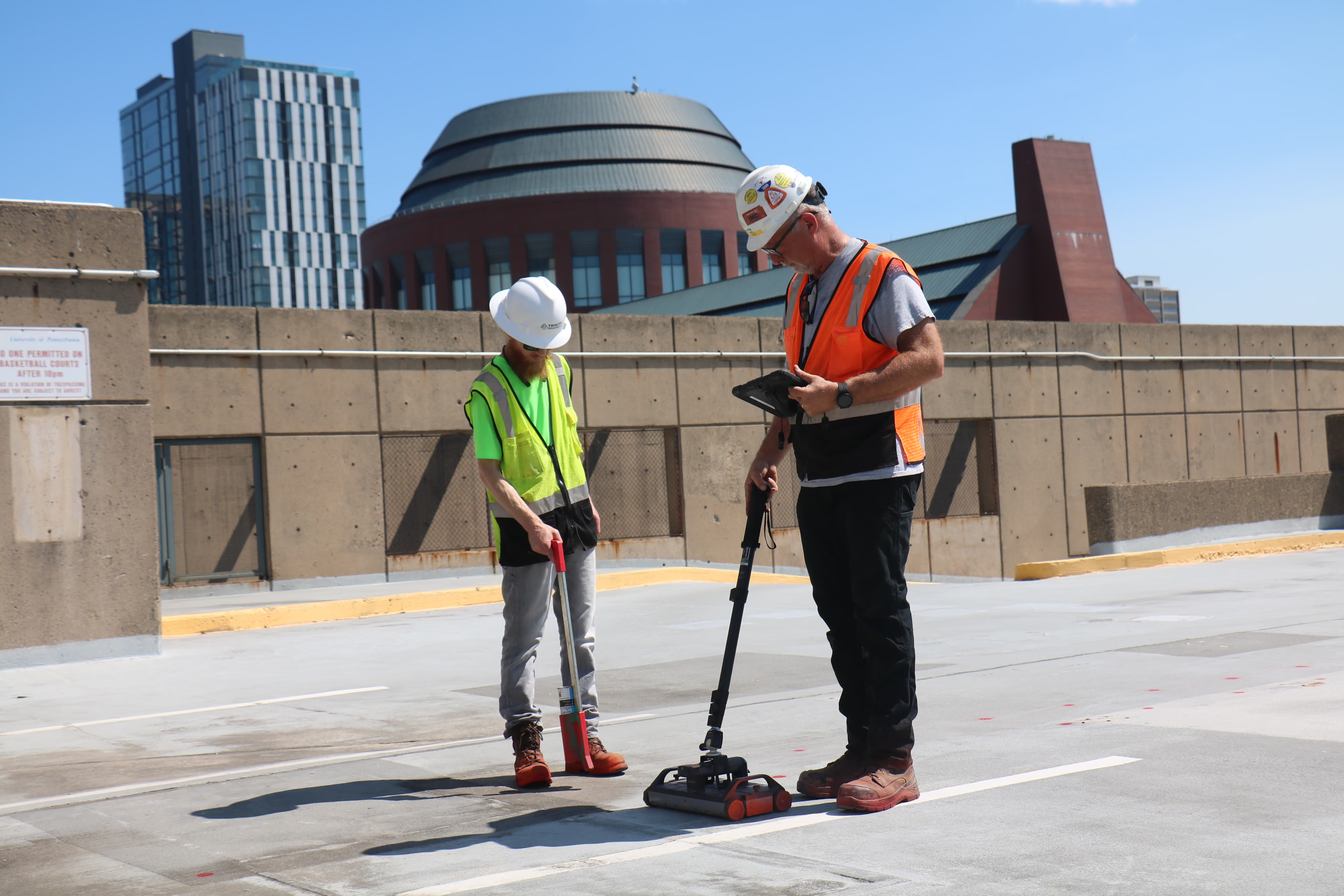
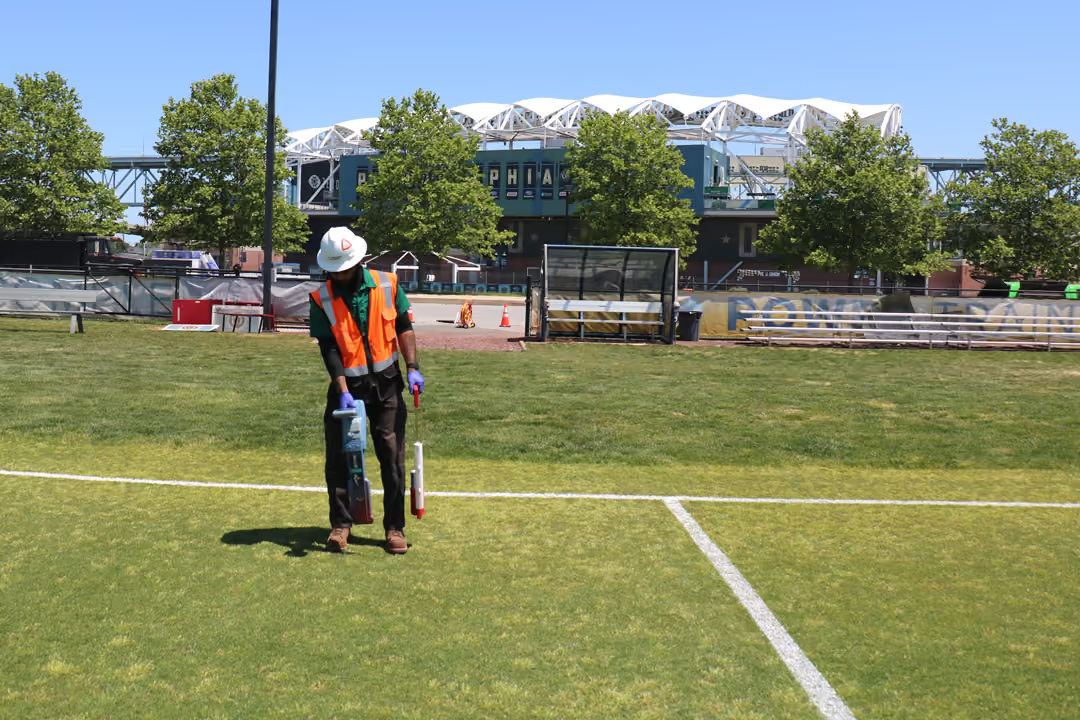
Miss Utility marks member-owned lines to the meter. Everything past that point on a Baltimore campus, hospital, industrial site or redevelopment parcel is private, and on older city sites much of it is non-metallic or abandoned. We locate metallic lines with Radiodetection RD8200 electromagnetic locators and use Proceq GS8000 ground penetrating radar for PVC, clay and abandoned pipe that electromagnetic locating cannot trace. Every locate is marked in paint and flags and documented on a field sketch within 24 hours.
For design teams and engineering firms, we deliver Subsurface Utility Engineering to ASCE 38: Quality Level B designating with electromagnetic and GPR equipment, and Quality Level A test holes that record depth, size, material and position of each exposed utility. Trinity is led by Greg Finkle, P.E., a professional engineer licensed in Maryland, Delaware, Pennsylvania and Florida, and our designating is delivered as CAD or GIS files tied to your project control.
Before coring or saw cutting in an occupied building, we scan slabs, decks and walls with GPR for rebar, post-tension cable and conduit, mark targets on the surface and keep a 3-inch buffer on every line that must not be cut. GPR emits no radiation, so hospitals and labs stay open while we work.
General contractors and construction managers, civil and survey engineers, hospital and university facilities teams, data center and industrial builders, and fiber and utility contractors. Rated 4.9 out of 5 from 223 Google reviews.
No. Member utilities mark their own facilities. Private lines on hospital campuses, universities, industrial sites and commercial properties need a private locator.
Most requests are on site within three business days, often sooner. Call (443) 779-6060 and our scheduling team will tell you what's possible.
Baltimore City and Baltimore, Anne Arundel and Howard counties, plus Annapolis, the Eastern Shore and Ocean City. We also cover Washington, DC.
Often, yes. Ground penetrating radar detects the pipe itself rather than a signal on it, so it can find PVC, HDPE and clay lines that electromagnetic locators miss. Depth, pipe size, soil moisture and clay content all affect what GPR can resolve, and we note any limits on the field sketch.
Trinity is led by Greg Finkle, P.E., licensed in Maryland, Delaware, Pennsylvania and Florida. Our SUE follows ASCE 38 and is delivered to Quality Level B or A as the project requires.
Rated 4.9 out of 5 from 223 Google reviews.
“Third time working with Trinity. Expertise, determination to find the problem and solution, resulting project summaries all outstanding. Highly recommend Trinity!”
Nancy T., Google review
“Their quote was provided promptly, and the technician was punctual, professional, and well-prepared. The work was clearly explained throughout the process.”
Frank B., Google review
“Trinity Subsurface is consistent in their high level of service, responsiveness, and quality of work.”
Craig H., Google review
For Whiting-Turner, EM and GPR designating for a switchgear and distribution replacement, with pipe camera tracing where sanitary lines could not be traced by EM or GPR alone.
Designated utilities and collected GPS on every mark so the client could drop them into its CAD base map.
Cleared a 60 by 5 foot excavation area on an active hospital campus before digging.
Located utilities along about 350 feet of planned duct bank for electric bus chargers, for Glenelg Construction.
Need concrete scanned too? See concrete scanning in Baltimore. Call (443) 779-6060.

